
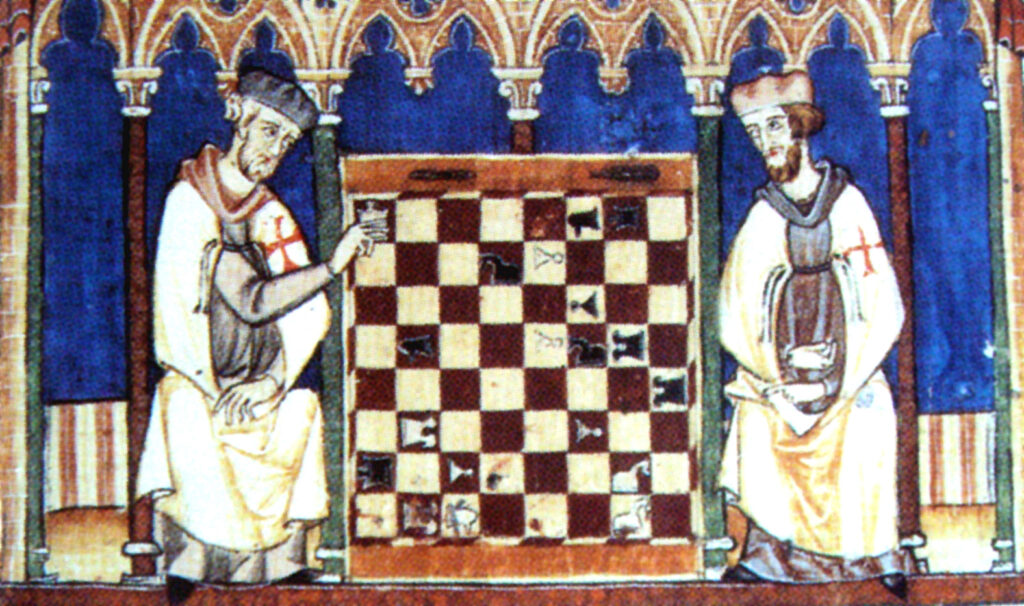
Seville, 1283
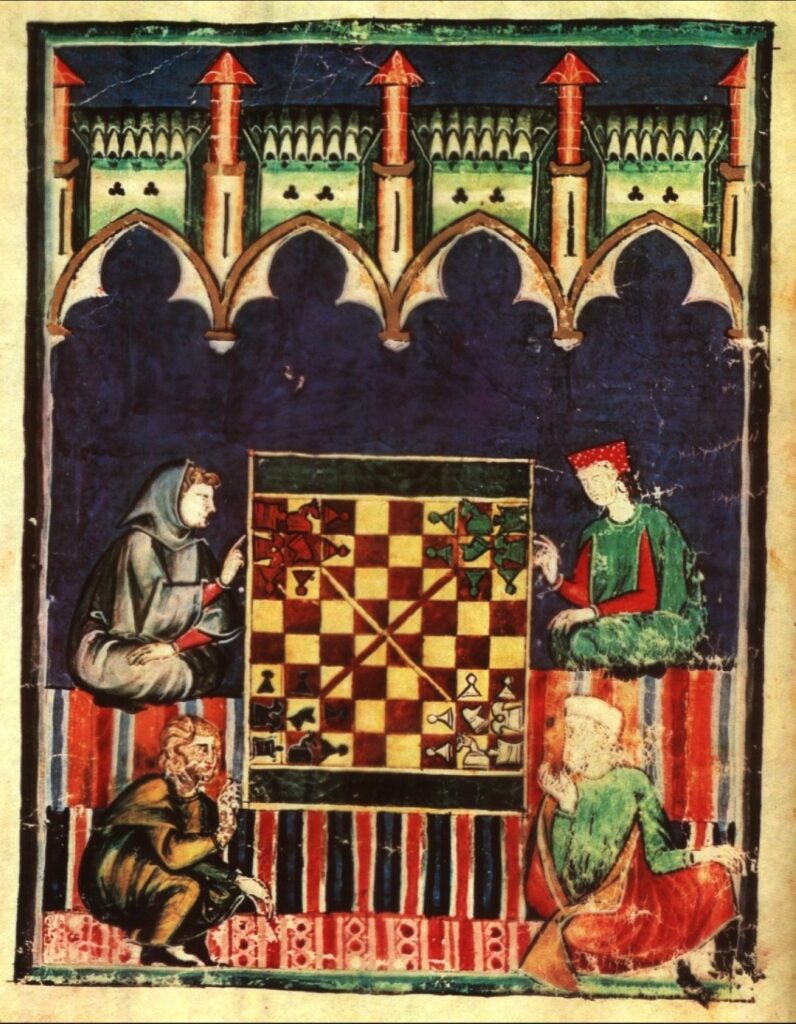
It was a very hot afternoon in summer at the castle during my residence in Seville back when I was a lady-in-waiting. We were to stay inside. Of course we were used to this; we never go far when the heat is unbearable. Being a woman, I usually got to play music, to sing or to weave. This particular afternoon as I was on my way to Milady, my eye caught an activity I wasn’t familiar with. I saw four man sitting at some kind of table with black and white squares on it. I couldn’t help myself, and went to see what the men were doing. I was a bit taken a back when I saw Milord was one of the four, but was forgiven for being nosy as he was very eager to tell about this activity. I learned the men were playing some game called chess.
The four men playing represented the four humors and the four elements. They played with pieces in four different colours. When I asked why this was, Milord told me it that white was the colour for winter, red for summer, green for spring and black for autumn. He went on to explain very in a enthusiastic way about kings, knights and pawns, of which I understood little, me being a woman. He said green always starts the game, and then apparently there was some strategy in playing. One would be wise to attack the player on the right hand side. This was to maintain the right order of the seasons in the game.
Milord had a book he recommended, newly written with all the rules for playing. My reading is not that good, and it would not be very appropriate for a woman to play such games, especially gambling money, but who knows. If you’re ever bored and can’t get out, this game might be interesting to you!
Sources:
- Alfonso X of Castile, Libro del Axedrez, dados e tablas, Real Biblioteca del Monasterio de San Lorenzo de El Escorial, 1283.
- Jean-Louis Cazaux, “Four seasons chess,” History of chess (ed. 2020), http://history.chess.free.fr/quatro-tiempos.htm.