

(For the actual recipe, see below)
I’ve been interested in Medieval cooking for a long while. Imagine being able to travel back in time with at least one of your senses.. But I never had a good reason to really try it. But this blog gives me many reasons to try new things, so I’ve started with this recipe right away. But it was when I only just started that I realised why I had put it off for so long..
Medieval recipes are very complicated. Or overly simplified, it depends how you view it.
People in the Middle Ages had lots of knowledge of cooking and baking. They didn’t need instruction on how to do basic stuff like bake a crust for a pie. So this is not mentioned in recipes. Specific proportions of ingredients are also nowhere to be found. The avarage Middle Ager had much experience in the kitchen and could figure out the measurements by themselves. Well, not me.
I’m actually not much of a baker anyway, but this gave me a challenge and I’m on it!
The second problem is, that there aren’t many Medieval cookbooks available. There are some that you can buy (and I definitely want to have), but the historian in me wants to work with source material. In this case I got a recipe from the Honesta Voluptate et Valetudine (‘’On right pleasure and good health’’) written bij Platina in the 15th century. It is a late-Medieval work from Italy. Italy didn’t have the same kitchen as the Netherlands, but as herbs traveled, so did recipes.
This book is filled with a lot of great texts that I want to use for some other blogs, but what struck my eye was the custard pie. As a beginner in the art of the Medieval kitchen, I didn’t want to take too much risk with weird flavors. I decided I wanted to bake this one.
The Medieval ‘’Recipe’’
So I looked at the recipe for the custard pie, and saw… A typical Medieval recipe. Well, that would take some experimenting before I could serve it to guests.
The recipe was as follows, translated into English by Mary Ella Milham:
‘Custard Pie for Lent
Soak well-pounded almonds with cinnamon, sugar, and rose water, and cook in the same way as above, but a little starch must be added so it becomes thicker.’
A very specific description indeed.
Above the recipe was another one for a regular custard pie, so I read that one as well, hoping for more information:
‘Make a little crust, as I described for rolls. Put in two well-beaten egg yolks, milk, cinnamon, and sugar. Stir for a long time on the fire until it becomes thick.’
So of course I went to search for the one for Rolls, so that I’d know which crust to bake. But it only said: ‘wrap in pastry that is thick enough and cook in the oven.’ This was as specific as it was going to get. Welcome to the life of a historian, haha!
Because the book didn’t give me much information, I needed to find some clues on how to bake the cake online. Information about the crust, making custard ánd specific preparation times. I compared different modern recipes for custard pie.
Recipes for custard pie
On the website of Eet!Verleden (translated to Eat!Past) they mentioned a common crust for pies was a ‘’sand crust’’ made of meal, butter, eggs and a little salt or sugar. Further research showed that lots of people making Medieval food need to improvise when it comes to the dough. I decided to make the crust Eet!Verleden mentioned, as that company is runned by historians that are specialised in culinary history.
Recipes for custard pie vary: in some recipes you first bake the crust, put a custard mix inside and heat it together. In others, both the crust and custard are baked in one go. A third option is baking the crust, making the custard, put it together and bake it again. As you understand, I had to choose an option. I picked the third option, as this would give the pie a more solid structure, that would be easier to eat.
So after my- admittedly not perfectly scientific- research, I had enough information to give it a go! This is how I made the cake:
So how to bake the Medieval Cake?
Step 1: Make an almond mix as filling
50 grams of almond; 7 teaspoons of rose water; 3 teaspoons of cinnamon; 2,5 tablespoons of sugar
I shred the almond in an onion-shredder. I added the rosewater and mixed it. Then I added the cinnamon and sugar. Let rest for a while.
Step 2: Make a dough for the crust
250 grams of flour, 125 grams of cold butter, 1 egg, pinch of salt.
Mix the dry ingredients. Add the butter and egg. Knead until it’s a good dough. If you use salted butter, add less salt. I added three tablespoons of sugar and one teaspoon of cinnamon, because I thought a Medieval person might also be inspired if these ingredients were already at hand.
Step 3: Bake the crust
Grease the baking mold. Distribute the dough along the bottom and edges. Put some aluminum foil on top, and something heavy on top of that. Like baking weights or dry beans. I don’t have those, so I put nails (like the ones you smash in the wall with a hammer) on the aluminum foil. By weighing it down you make sure the crust stays in a good shape to fill later on. Bake for 30 minutes at 180 degrees celsius.
Step 4: Make the custard
500 ml milk; 4 egg yolks; 2 teaspoons cinnamon; 2,5 tablespoons of cornstarch (or other starch); 50 grams of sugar.
Heat the milk with the cinnamon until it’s close to boiling. Stir the 4 egg yolks with cornstarch and milk. Put off the fire under the milk, and with a soup spoon, slowly pour the milk in the bowl with the egg mixture whilst constantly stirring the egg mixture. When everything is mixed, pour it back in the pan. Put on low fire and constantly keep on stirring. Don’t let it boil! The egg will clot into scrambled eggs. Which is yummy, but not in a sweet cake. Add the almond mixture while you keep on stirring. The custard is done when it’s a thick mass.
In many modern recipes for custard, you’ll use cream. Cream isn’t mentioned in Platina’s recipe. I did some research, and milk in the 15th century should be comparable to ‘whole milk’. The cream was taken off in the processing, just as now. Using whole milk should get comparable results to the actual ingredients used in Platinas time.
Step 5: Put the custard and crust together and bake again
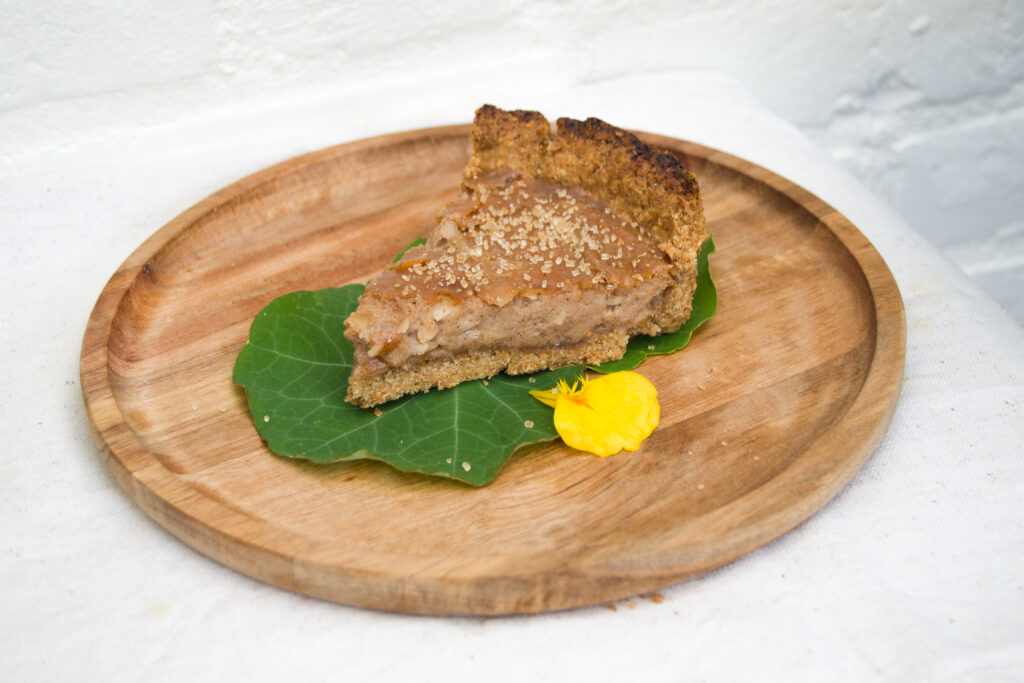
After the crust is baked, remove the foil and the nails to make sure the cake won’t be too heavy. Pour the custard in the crust, and put the cake in the oven for an additional 60 minutes on 120 degrees celsius. Turn down the heat a little bit if the crust seems to be burning. After 60 minutes your pie will be done! Let it cool off with the oven door ajar. Sprinkle the top of the cake with some rosewater and sugar before serving, et voila; your Medieval cake is done!
How does the custard pie taste?
I took a little taste of the pie after it cooled down. I had secretly tried a little bit of the crust before, and it wasn’t really sweet.. I was afraid the entire cake wouldn’t taste good, but that’s certainly not true! Combined with the filling, it was great; sweet enough and lots of flavour. The taste reminds me of filled speculaas, which is a typical Dutch cookie which in its turn slightly resembles gingerbread. If you don’t like this kind of flavour, I’d add less cinnamon. You can also bake the pie without almond or with more sugar or some apple on top. I’m very content with this cake and served it to my family. They enjoyed the experience of trying medieval flavours!
Sources:
–Platina, on right pleasure and good health: a critical edition and translation of De Honesta Voluptate et Valetudine door Mary Ella Milham, 1998.
–www.eetverleden.nl ☺